Three Nights in the Pinery Bookended by Storms: Burley, Dunes, Riverside, and Which One to Book
Pinery Provincial Park sits near the southern end of Lake Huron, about an hour from London or Sarnia and roughly three hours from the GTA. It protects 10 km of sand beach and something much rarer behind it: a dune-and-oak-savanna system that belongs several hundred kilometres further south. Over 99.93% of the world’s oak savanna has been destroyed or altered, and Pinery now protects close to half of what remains. The dune ridges run more than 9.5 km along the shore and took about 6,000 years to build. On a narrow strip of land between two great lakes, the park is also a migration funnel — over 320 bird species recorded, and monarchs staging through on their way south.
We booked our end-of-summer vacation with our young adult children in Burley campground back in February. We watched a storm form over the forecast in the days before we drove, went anyway, survived one storm, enjoyed a gorgeous day at the beach, and drove off hours before a second one.
Quick answer: Pinery has three campgrounds — Burley (195 sites, unserviced), Dunes (296 sites, 46% electrical) and Riverside (482 sites, 82% electrical). Want a tent site under pines with no hookups, book Burley; want services, book Riverside. But the surprise in our data is that your odds of a private site are almost identical in all three (28–30% rated Good for privacy). What actually moves the needle is which area you book: Riverside Area 4 rates 47% Good, Riverside Area 1 just 4%. Note also that the direct road to Burley has been removed and converted to a cycling route — you now drive in through the Dunes campground.
The three campgrounds, and the numbers behind them
Our catalogue holds 11 booking areas at Pinery, grouped into the park’s three campgrounds. Here is what they actually look like as a set — 973 sites in total, which is what our zone data covers (the park’s own count is 1,010, the difference being the group and walk-in sites that aren’t zone rows).
| Campground | Sites | Electrical | Rated Good for privacy | Rated Poor for privacy | Road noise | Character |
|---|---|---|---|---|---|---|
| Burley (Areas E–I, J–Q, R–U) | 195 | 0 (0%) | 59 (30%) | 52 (27%) | No highway or major road within 2 km | Furthest from the main gate, entirely unserviced, sites among mature pines. Open May–September. |
| Dunes (Areas 1–4) | 296 | 137 (46%) | 84 (28%) | 94 (32%) | No highway or major road within 2 km | Closest to the beach and the day-use facilities. Area 4’s 53 sites are the park’s dog-free block; Area 1 is 73% electrical, Area 3 has none. Open May–September. |
| Riverside (Areas 1–4) | 482 | 395 (82%) | 145 (30%) | 95 (20%) | ~49.5 dB estimated; nearest primary road 1,086 m — “probably quiet” | Strung along the Old Ausable Channel. Area 1 is the year-round area; Area 3’s 66 sites are the park’s radio-free block. |
Three things fall out of that table that the reservation site won’t tell you.
Privacy barely varies between campgrounds — but hugely within them. Burley 30%, Riverside 30%, Dunes 28% of sites rated Good. That is a rounding error. Book by campground and you have not improved your odds at all. Book by area and you have: Riverside Area 4 rates 84 of its 177 sites Good for privacy (47%), while Riverside Area 1 rates 5 of 130 (4%) — the two extremes of the whole park sit inside the same campground. Burley Area E–I is the best of the Burley loops at 41%.
Burley is the only fully unserviced campground. Not “mostly” — zero of 195 sites have electrical. That is the real difference between the three, and it is why Burley feels different: no hookups means no big rigs and no generators, and the campground is furthest from the gate on top of that.
Pinery has no loud campground. Burley and Dunes have no highway or major road within 2 km at all; Riverside’s nearest primary road is over a kilometre away and models out at around 49.5 dB, which lands in our “probably quiet” bucket. This is worth stating plainly because our own agent used to get it wrong. Pinery’s campground coordinates were badly off in our catalogue until we corrected them in August 2026: the bad point for Burley sat on the Highway 21 frontage, 4.5 km from the actual campground, and our noise model duly reported Burley as the loudest campground at Pinery. It is the quietest. Coordinates fixed, verdicts recomputed.
Staying there confirmed it: at site 1224 traffic noise was effectively nil. But it’s worth being precise about what that model does and doesn’t measure. It measures roads and rail. It does not measure dogs, children, or neighbours. We heard all three — and it was fine, well within what you’d expect and a long way from what a busy campground can be like. The thing that made it fine wasn’t the acoustics, it was that people at Pinery largely respect each other and keep the noise down.
Which is worth knowing, because if social noise is what you’re actually worried about, the lever isn’t the campground — it’s the blocks the park has already set aside. Dunes Area 4 is the dog-free one, 53 sites. Riverside Area 3 is radio-free, 66 sites. Neither shows up in a noise model, and both do more for your evening than any distance-to-highway figure.
The Burley road is gone
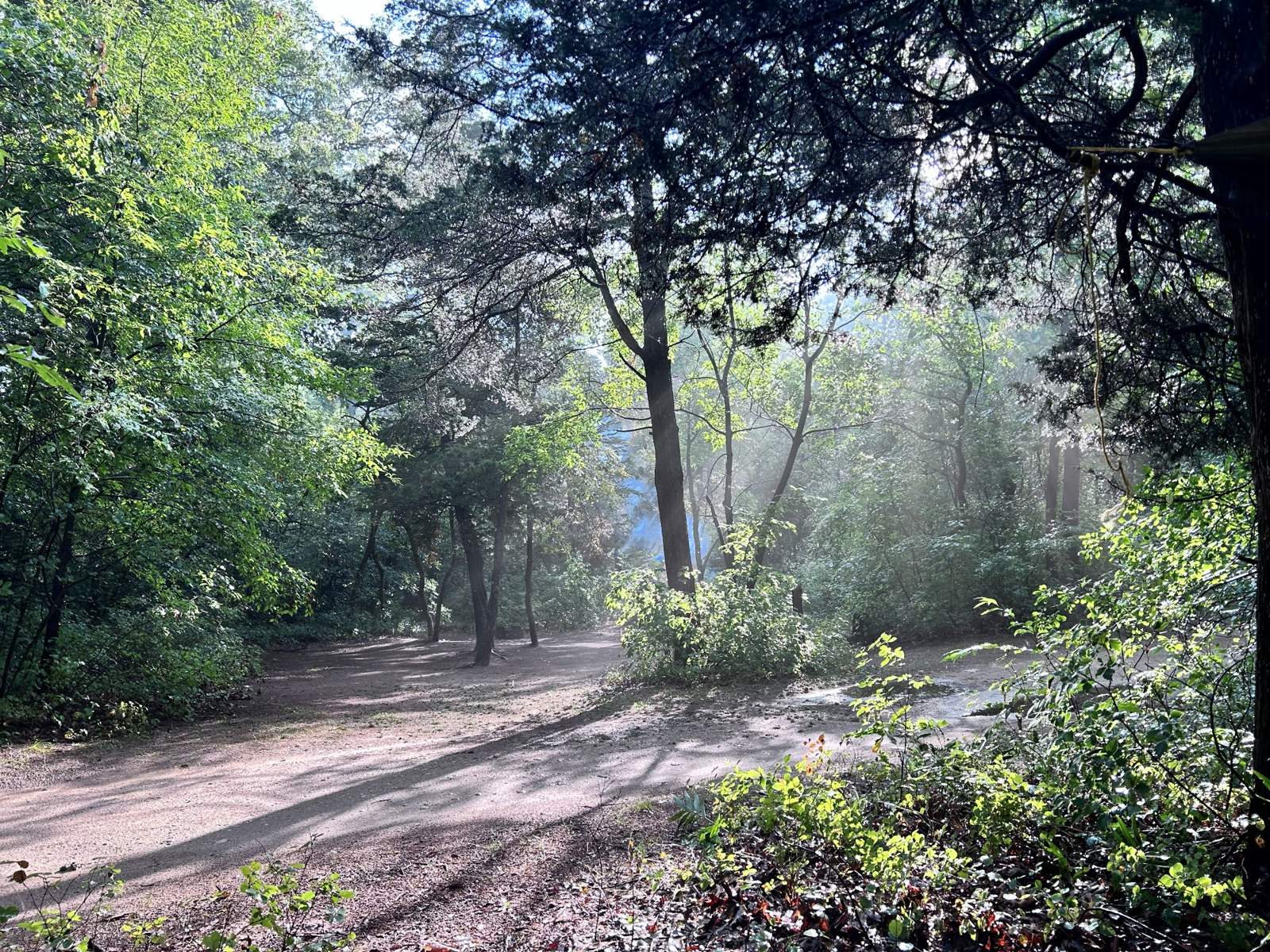
The most useful thing we can report from this trip isn’t in any dataset. The direct access road to Burley, and the entrance building that stood on it, have been removed. The roadbed is now a cycling route. Vehicle access to Burley is through the Dunes campground.
If you have camped at Pinery before and are navigating from memory, or following an older park map, plan for this. It adds a few minutes and it is not signposted the way an old hand would expect. As of drafting, ontarioparks.ca doesn’t mention the change on either the park page or the camping page, so this is our own observation from a stay ending 2 September 2026 rather than something you can go and verify on the park’s site.
What the park hasn’t posted, the province has. Environmental Registry notice 026-0675, an amendment to Pinery’s management plan posted on 3 July 2026 with comments closing on 17 August, proposes an “addition to the nature reserve, natural environment zone and reduction in development zone to support Burley Campground restoration” — under a name the plan uses directly: Rewilding Burley. Its implementation priorities list it as “Rewilding Burley — restoration and recreation development.” A campground road becoming a bike route is precisely what those five words look like on the ground.
That reframes the whole thing. This isn’t maintenance, it’s policy. Around 91 campsites have already been removed park-wide and up to 200 more are proposed, to protect the oak savanna and the dunes that make Pinery worth protecting in the first place. And Burley has absorbed nearly all of it so far: the standing management plan document describes “Burley, with 302 campsites,” while the reservation system today offers 195. That is more than a hundred sites gone from one campground.
Which is the honest tension in this post. The campground we liked best is the one being made smaller, and the reason it is being made smaller is the reason it is nice. If you want to camp in Burley, the number of chances to do it is going down, not up.
The upside for cyclists is real, though: a car-free former park road is a genuinely nice thing to ride, and it plugs straight into the park’s 14 km bike trail.
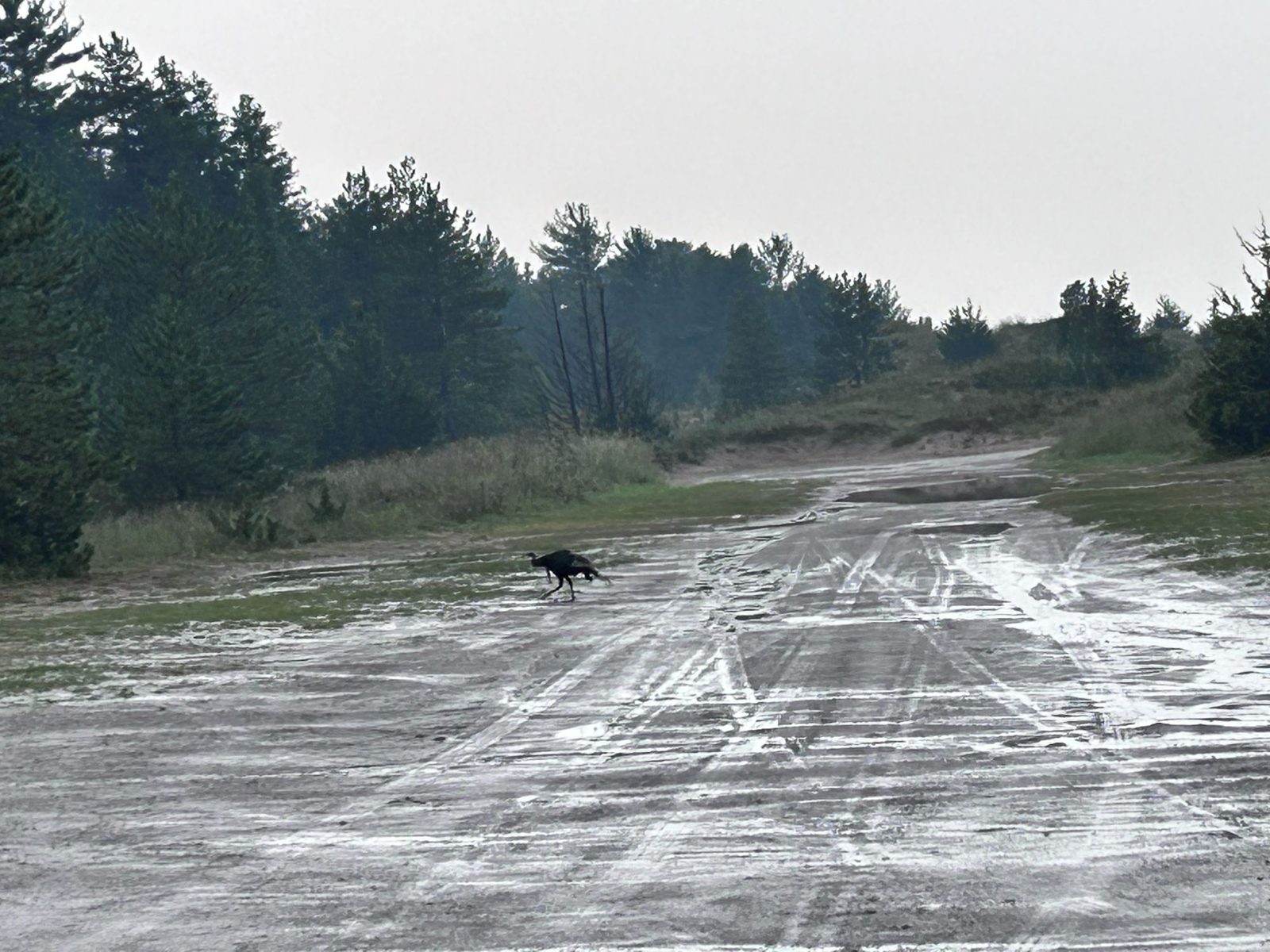
What actually happened: three nights in a storm
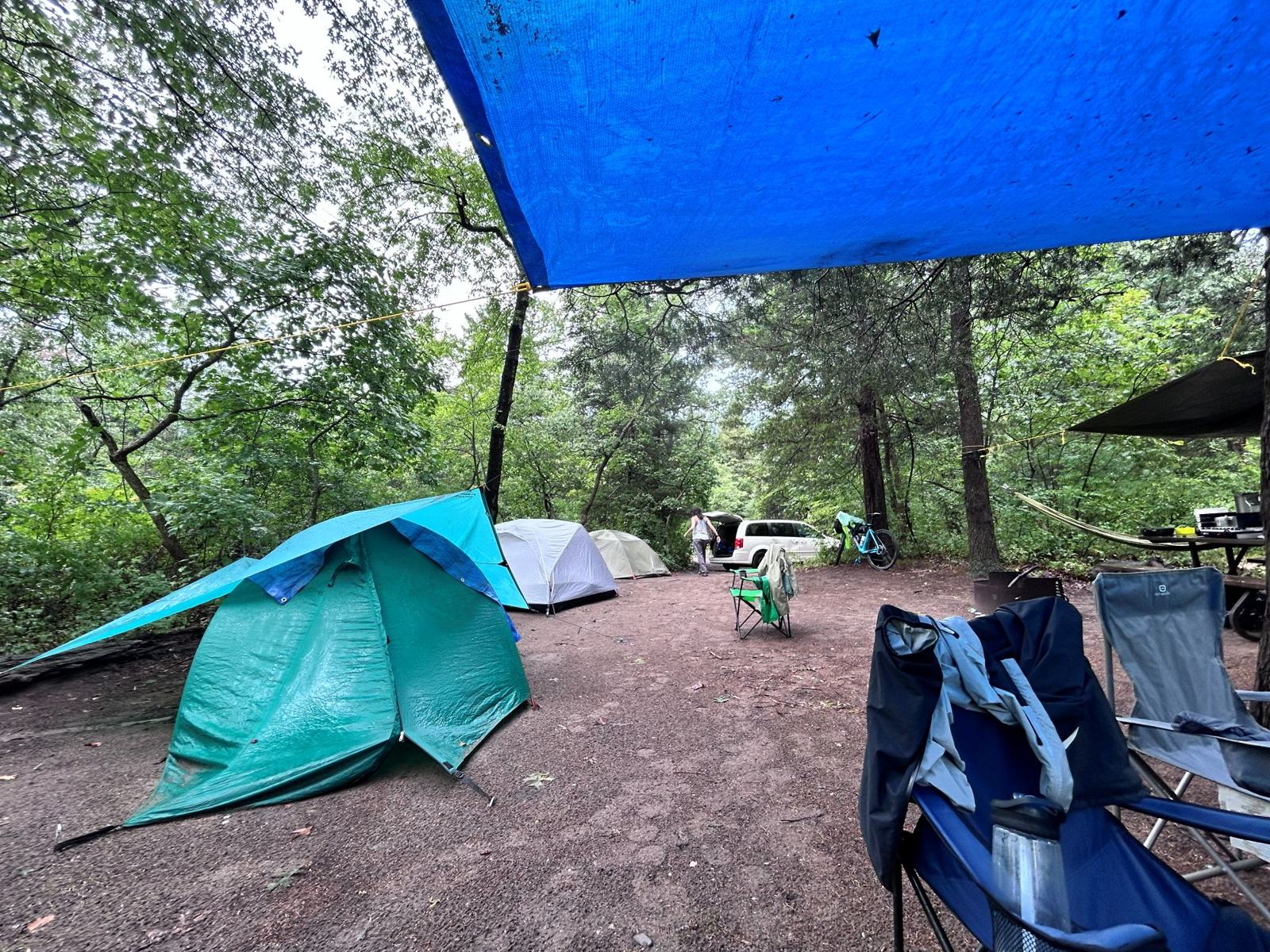
We picked site 1224 in Burley looking for the same things we always look for — a big site, a path to the beach, and bathrooms close enough to matter at 2 a.m. Six of us, three small tents.
As the trip got closer, the forecast turned. Several weather apps and the Campaid agent — which pulls Environment and Climate Change Canada data directly — converged on the same answer: a storm, arriving about when we would. Sites are non-refundable that close in, so we drove anyway.
We drove into the park as the rain started, sat in the car for a while, and waited for a gap. When it came we pitched everything fast. Site 1224 turned out to be exactly right for this: room for three tents, and enough trees to rig two tarps — one over the picnic table, one over the folding chairs, which is our standard wet-weather layout and the reason a rainy trip is still a good trip.
The first 24 hours were close to non-stop rain, and it was serious rain: roughly 35 mm. There’s no weather station inside Pinery, but the two nearest Environment and Climate Change Canada stations bracket it — Goderich recorded 35.5 mm between Sunday morning and Monday evening, Sarnia 39.3 mm. Most of it fell in a single Sunday afternoon and evening block, 8.1 mm of it in one hour.
Warm rain, though, which changes everything. The tarps did their job and nobody suggested going home. But 35 mm in a day is more than a tent fly is designed to shrug off, and ours — decent tents, not cheap ones — started to seep. We ended the first night with damp sleeping bags.
What saved us is worth knowing before you cancel a wet booking: Pinery has laundry facilities, and $4 in change through the dryers had the bags dry again. A park with a laundromat is a different proposition in a storm than one without, and the reservation page never mentions it.
I did try to ride out to Port Franks that first day and turned around halfway — there is a difference between riding in rain and riding in that rain, and the tarp over the picnic table was the better place to be.
The storm clearly scared some people off. The loop wasn’t empty, but it was noticeably below what the last weekend of August looks like in one of Ontario’s busiest parks — a fair number of sites sat unused. Friends of ours, a party of five, booked the site next door at the last minute precisely because the cancellations had opened it up. They cancelled their own first night, waited out the worst of it in a café in Grand Bend, and rolled in as the rain stopped to set up on site 1125 — another good one, plenty of trees and real separation from the neighbours.
The one genuine nuisance was deer flies. We were swarmed on the beach on day two. By day three they had vanished completely, which is roughly how deer flies work — a short, ferocious season that ends abruptly.
The lake, which did not read the forecast
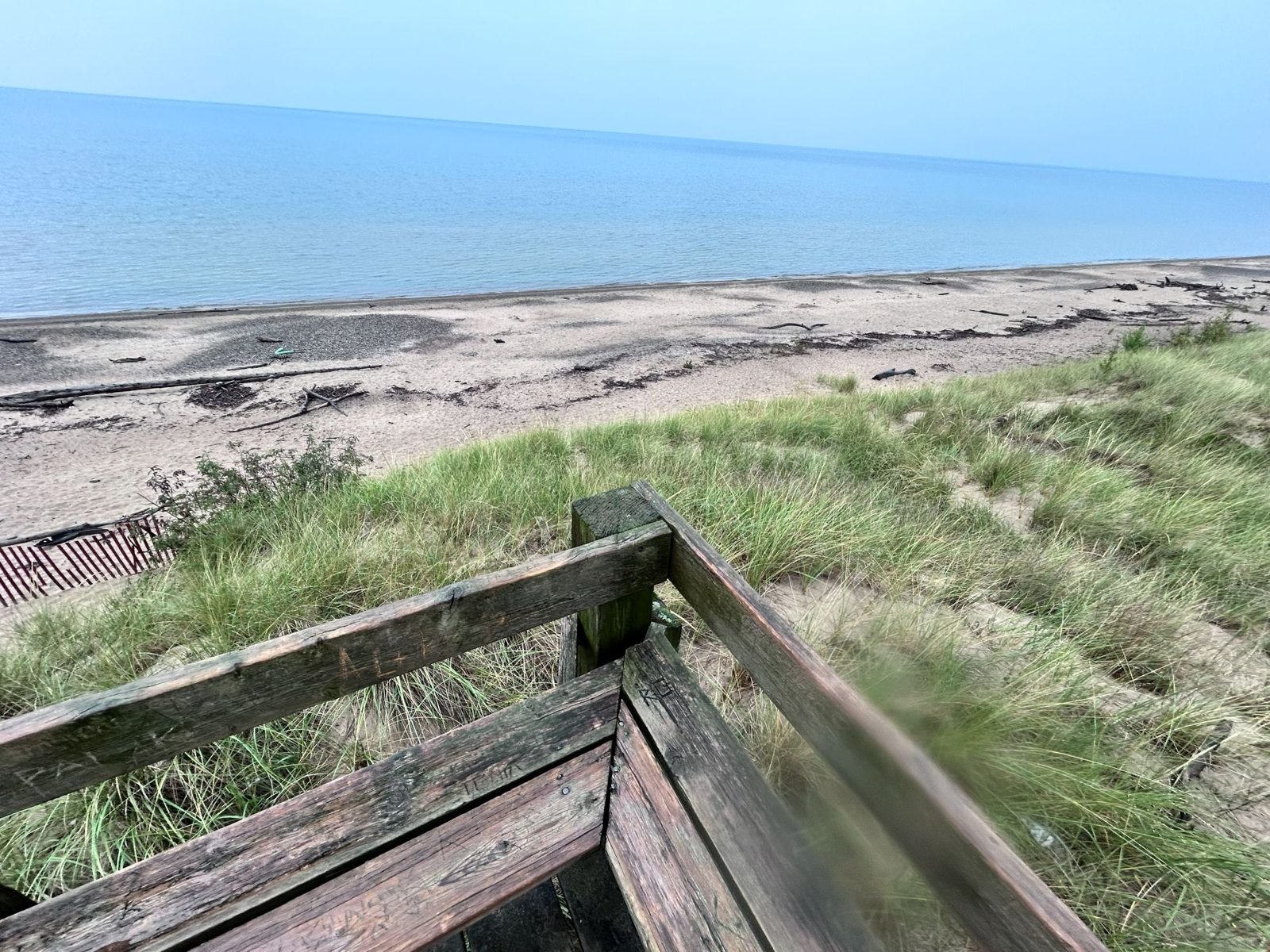
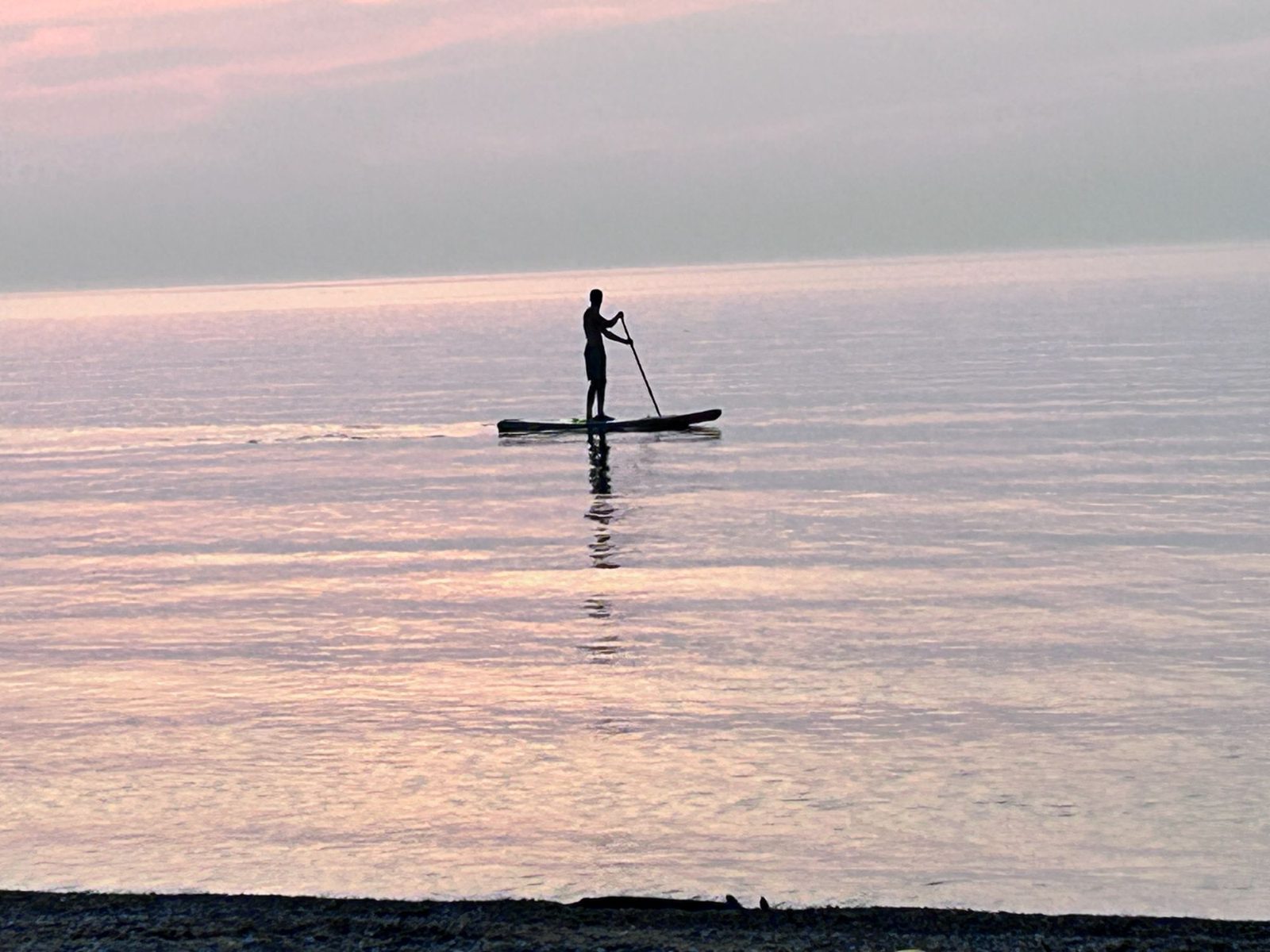
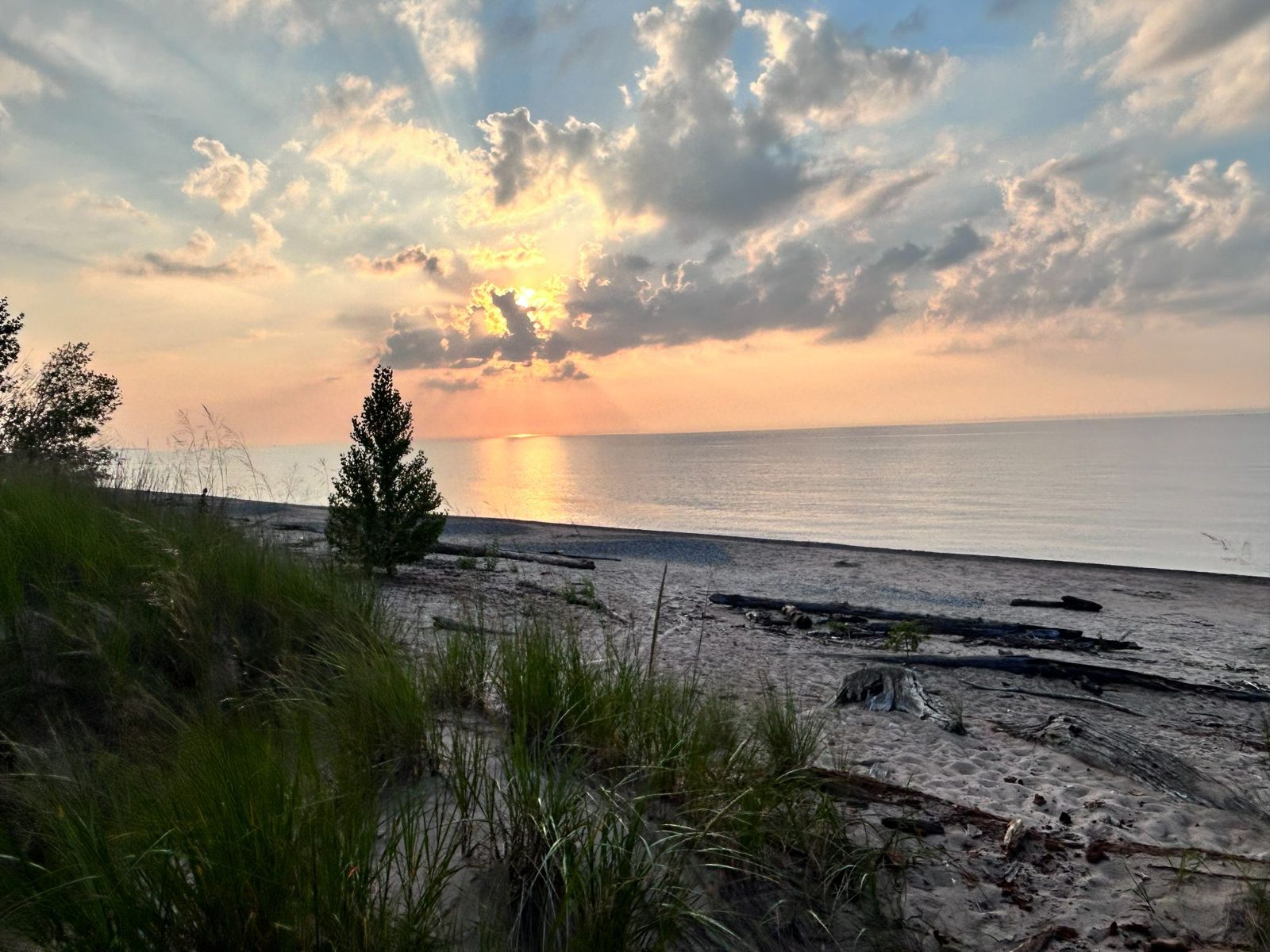
Here is the part that surprised us most. Through all of it, Lake Huron stayed calm and stayed warm. The water was cloudy rather than clear — that’s the storm churning up sand, and it’s normal after weather — but it was excellent for swimming. I swam about 500 m a day. Our friends brought paddleboards and got real use out of them on flat water.
Worth internalising if you are weighing whether to cancel a Lake Huron trip over a forecast: a storm that ruins your beach day can leave the swimming better than a bright, windy day would. Onshore wind is what makes this shoreline unswimmable, not rain.
The second storm, which we drove into
We cleared the site by 2 p.m. on Wednesday, which is checkout at Ontario Parks, and pointed the car at Toronto. That turned out to be the most weather of the whole trip.
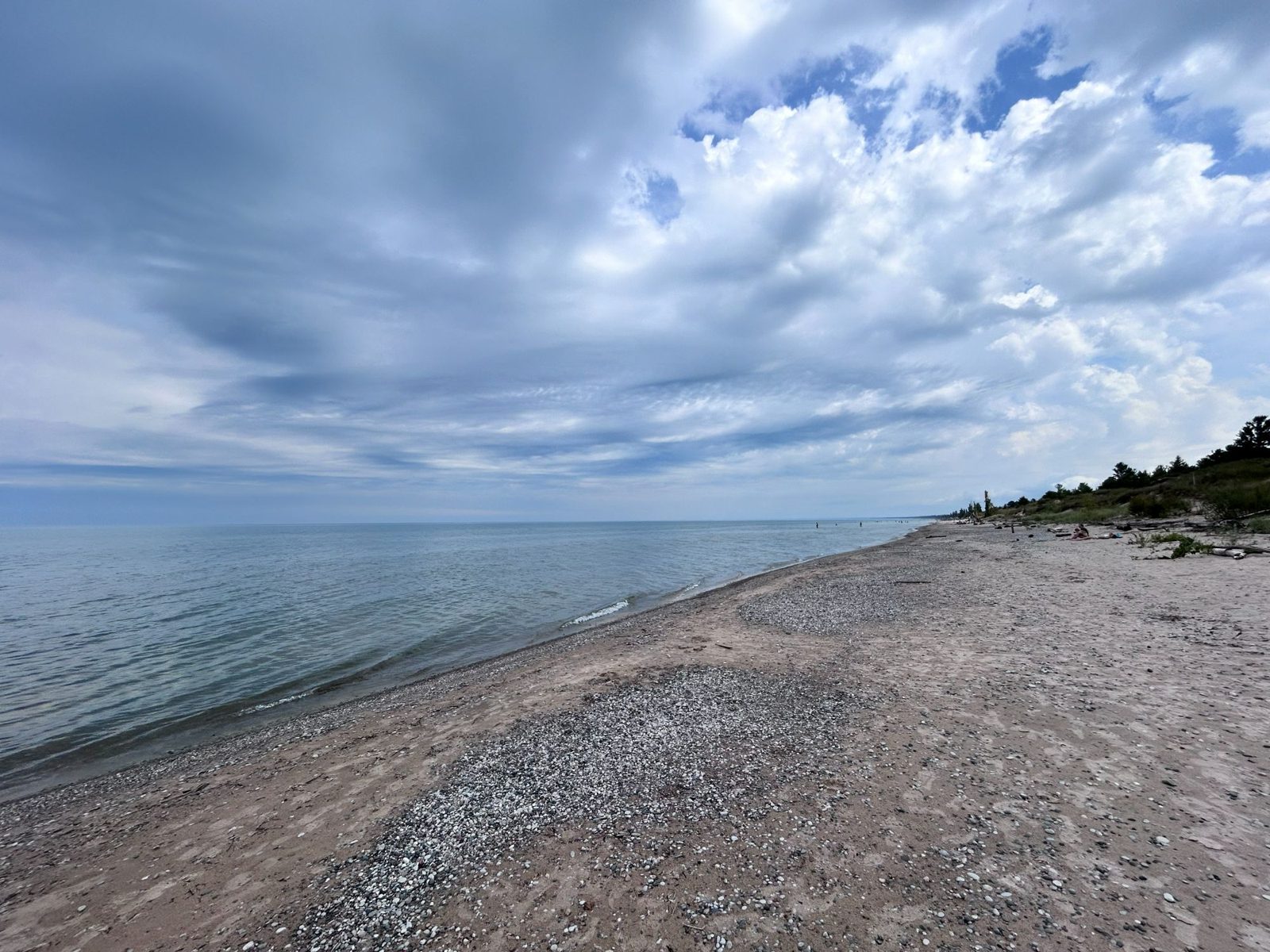
The morning had been hot and still — Sarnia, 40 km down the coast, hit 34.6 °C that afternoon. Then it broke. The sky went dark as we passed London, and from there to Toronto we had rain hard enough to make the 401 genuinely difficult and tornado warnings arriving on our phones the whole way. That wasn’t our imagination: Environment Canada had a radar-confirmed tornado warning running from Stratford through Waterloo and Guelph, a storm near Clinton at 4:50 p.m. it called life-threatening, and a tornado advisory over Toronto with gusts above 110 km/h possible. The City of Toronto activated its emergency operations centre.
At Pinery itself the same system delivered about 10–15 mm and gusts of 35–60 km/h. Sitting dry in a car on the highway, we were all thinking about the tents we’d just packed — and about the people who hadn’t.
Tuesday had been calm, hot and swimmable. Wednesday was a severe weather event across the whole of southwestern Ontario. Same shoreline, 24 hours apart.
What we would do differently
Weather on this coast is unstable, and both ends of our three nights proved it. The response isn’t to avoid Pinery — it’s to book with slack in it.
Book a longer window than you need and drop the first or last night once the forecast firms up. Be clear-eyed about the cost: Ontario Parks charges a cancellation penalty of 10–50% of the value of the nights you drop — the full 50% if you’ve held the booking more than four months, which you will have if you booked at the five-month opening — plus an $8.50 online fee, and inside 72 hours of arrival you forfeit the first night outright. The slack is worth paying for, but it isn’t free, and the call has to be made early enough to be worth making. Our friends did exactly that, and had a better first night than we did.
Come equipped either way. Good tents aren’t enough on their own — ours seeped at 35 mm. Tarps, and a site with enough trees to hang them from, are the difference between a wet trip and a ruined one.
Riding out of Pinery
Pinery has a 14 km paved bike trail inside the park with rentals available, and it also sits in genuinely good riding country — flat to gently rolling farmland, quiet concession roads, and Lake Huron as a constant reference on your left. I brought a gravel bike and got two rides out of the three days: a 63 km loop inland to Rock Glen Falls at Arkona, and a 22 km loop around the park itself — an hour and seven minutes, and it never leaves the park. The third, out to Port Franks on day one, I abandoned halfway when the rain came in hard.
Both rides, with the routes and what they’re actually like, are their own post: Two gravel rides out of a Pinery campsite.
The rest of what there is to do
The Old Ausable Channel runs the length of the park behind the dune ridge — a provincially significant wetland with canoe, kayak and stand-up paddleboard rentals, and flat, sheltered water that works when the lake doesn’t. There are 10 walking trails, all short; the point of them is the ecosystem rather than the distance, and the interpretive ones through the savanna are worth doing at least once to understand what you are camped in. Mountain bike rentals are available in the park. In winter the same ground carries 38 km of groomed cross-country ski trails.
If you have half an hour, walk a savanna trail and count canopy: an oak savanna is defined as 25% or less canopy cover, and Pinery’s is held open by seven oak species and by prescribed burns. It looks like a forest that someone thinned. It is actually one of the rarest habitat types on the continent, and the reason the park’s plant list runs past 850 species.
How we know all this
Campaid is a booking assistant for Canadian camping trips. It checks live availability across Ontario Parks, Parks Canada, Sépaq and more — per night rather than as a single sold-out yes/no — and factors in what the booking page never tells you: fire bans, road and rail noise, how exposed a site is, weather from Environment and Climate Change Canada, and drive time from where you actually live. The privacy, shade and electrical figures in this post come out of our own park catalogue, which is why we can compare Riverside Area 1 against Riverside Area 4 rather than just saying “Riverside.”
We also go and camp in these places, which is how the Burley road change got into this post at all. If you have been to Pinery recently and something here is out of date, tell us.
Frequently asked questions
Which campground is best at Pinery — Burley, Dunes, or Riverside? It depends on services, not on privacy. Burley (195 sites) has no electrical sites at all and is furthest from the gate — the quietest and the most tent-oriented. Riverside (482 sites) is 82% electrical and runs along the Old Ausable Channel, with the park’s only year-round area. Dunes (296 sites) is closest to the beach and day-use area and is 46% electrical. Privacy ratings are nearly identical across all three (28–30% of sites rated Good), so pick on services and location.
Which Pinery sites are the most private? Riverside Area 4 has the highest share in the park — 84 of its 177 sites rate Good for privacy (47%). Burley Area E–I is next at 41%. Avoid Riverside Area 1 if privacy is the priority: just 5 of its 130 sites rate Good (4%), the lowest in the park.
Does Pinery have electrical sites? Yes — 474 park-wide by Ontario Parks' own count. But they are unevenly spread: Riverside is 82% electrical, Dunes 46%, and Burley has none. If you need a hookup, do not book Burley.
How do I get to Burley campground now? Through the Dunes campground. The direct road to Burley and its entrance building have been removed and the roadbed converted to a cycling route — we observed this on a stay ending 2 September 2026. The park’s website does not yet describe the change, so allow extra time on arrival.
What is Rewilding Burley? A named restoration program in the proposed amendment to Pinery’s management plan (ERO 026-0675, posted 3 July 2026, comments closed 17 August): part of the Burley area is rezoned from development to nature reserve and natural environment, listed under implementation priorities as “restoration and recreation development.” It is the context for the road removal. Park-wide, around 91 campsites have already gone and up to 200 more are proposed, to protect the oak savanna and dune systems.
Is Pinery losing campsites? Yes. Around 91 have already been removed and the proposed management plan amendment would allow up to 200 more where sites, buildings or campgrounds are found to affect the park’s ecological integrity. Burley has taken most of it so far — the management plan document lists it at 302 sites and the reservation system now offers 195.
Is Pinery noisy? Not for traffic. Burley and Dunes have no highway or major road within 2 km, and Riverside’s nearest primary road is more than a kilometre away, modelling at roughly 49.5 dB — and staying in Burley confirmed it, with road noise effectively nil. Social noise is a separate question that no noise model answers: you will hear dogs, children and neighbours. We found it well within reason, helped by a culture at Pinery of people keeping it down. If it’s a concern for you, book Dunes Area 4 (dog-free) or Riverside Area 3 (radio-free).
Is it worth camping at Pinery in the rain? It was for us. The lake stayed calm and warm enough to swim in all three days despite the storm — onshore wind, not rain, is what ruins swimming on this shoreline — and the storm forecast left our loop noticeably quieter than the last weekend of August usually is. Bring tarps and enough trees to hang them from. We took about 35 mm of rain in 24 hours and our tents did start to seep; the park’s laundry facilities dried our sleeping bags for $4 in change, which is the detail that turned a soggy trip back into a good one.
Are there bugs at Pinery? Deer flies, in season, and they can be bad on the beach. We were swarmed on one day of three and saw none at all on the last day; their season is short and ends abruptly.
Campaid checks live availability across Ontario Parks, Parks Canada, Sépaq and more — per night, with cancellations, noise, privacy and fire bans factored in. Try it free.